The Coverage Advantage: How Modest Dressing Creates the Illusion of Height, Proportion, and Effortless Polish
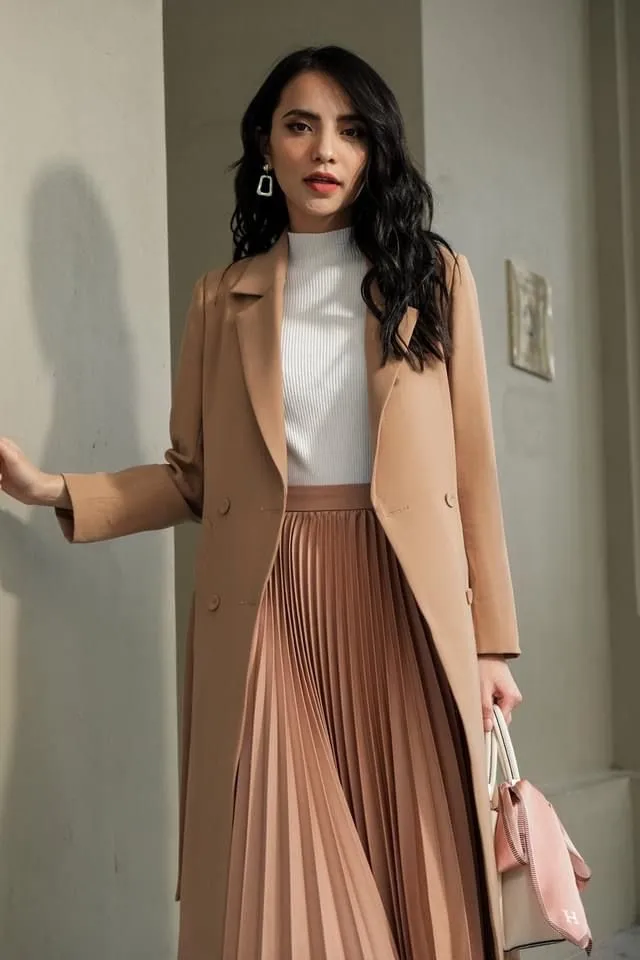
Photo: elegant modest fashion woman monochromatic outfit long skirt tailored blazer studio portrait, via i.pinimg.com
For decades, mainstream American fashion commentary has operated on a single, largely unquestioned assumption: that revealing more of the body is the surest path to looking taller, leaner, and more striking. Hemlines are raised to elongate legs. Necklines are lowered to create the impression of height. Sleeves are eliminated to suggest a longer, leaner arm. The logic seems intuitive — and yet, when examined through the lens of genuine optical science and proportion theory, it collapses rather quickly.
The truth is that strategic coverage — the deliberate, considered use of fabric, silhouette, and layering that defines modest dressing — produces some of fashion's most powerful visual effects. When a woman understands why her covered wardrobe works the way it does, she stops dressing defensively and begins dressing with real authority. What follows is a practical, science-grounded guide to the aesthetic advantages that modest style has quietly held all along.
The Myth of the Exposed Leg
The most persistent piece of fashion folklore is that a shorter hemline makes the legs appear longer. In practice, this is only partially true — and the conditions under which it works are far narrower than most style advice acknowledges.
Exposing the leg creates a visual break between the garment and the body. The eye is drawn to the point of transition, which, depending on where that break falls, can actually interrupt the vertical line and make the figure read as shorter or more segmented. A midi skirt that hits just below the knee, by contrast, keeps the eye traveling downward in an unbroken sweep, particularly when paired with a shoe in a complementary tone. A floor-length skirt in a single, rich color produces perhaps the most dramatic elongating effect of all — the silhouette becomes one continuous vertical column, and the figure reads as genuinely statuesque.
This is not theory. It is the same principle that interior designers use when hanging curtains from ceiling to floor rather than from window frame to sill: the uninterrupted vertical line commands space and creates the impression of height far more effectively than a shorter, interrupted one.
Monochromatic Dressing and the Power of Visual Unity
One of the most elegant tools in the modest wardrobe is also one of the most underappreciated: the coordinated, head-to-toe color story. When a woman dresses in a single color family — a blouse, wide-leg trousers, and a structured blazer in varying shades of ivory, for instance — the eye perceives the entire figure as a unified whole rather than a series of separate pieces.
This visual unity is profoundly elongating. The absence of sharp color contrast between top and bottom means there is no horizontal interruption across the midsection, which is precisely where most women would prefer the eye not to linger. A bright top paired with dark trousers, by contrast, creates a strong horizontal band at the waist — drawing attention to exactly that point and visually dividing the figure in two.
Modest dressing, with its natural inclination toward layered, coordinated outfits, lends itself beautifully to this approach. A long cardigan in the same tonal family as the dress beneath it, or a tailored coat that echoes the trousers below, produces a seamless vertical line that reads as both refined and remarkably slimming.
Vertical Lines: The Architecture of Elegance
If monochromatic dressing is the painter's approach to proportion, vertical lines are the architect's. Seams, pleats, button plackets, pinstripes, and the natural fall of a well-cut garment all serve as vertical guides for the eye — and the eye, obediently, follows them upward and downward, reading the figure as taller than it is.
Modest garments are, by their very construction, rich in vertical detail. A classic shirt dress with a center button placket running from collar to hem is a masterclass in vertical line. Wide-leg trousers with a pressed center crease direct the eye straight to the floor. A long, open-front cardigan creates two parallel vertical lines down the front of the body — one of the most flattering effects achievable in everyday dressing.
This is why the modest wardrobe, far from being a visual liability, is in fact architecturally advantaged. Its longer hemlines, fuller sleeves, and layered constructions are naturally inclined toward the vertical — and the vertical, in fashion as in architecture, is the language of height and grandeur.
The Intentionality Factor: Why a Covered Outfit Reads as More Polished
Beyond the mechanics of optical illusion, there is a subtler but equally powerful phenomenon at work in modest dressing: the perception of intentionality. A covered, layered, coordinated outfit requires thought. It requires an understanding of proportion, color, texture, and silhouette. And the human eye — even an untrained one — recognizes and responds to that effort.
When a woman walks into a room wearing a thoughtfully assembled modest outfit, observers perceive deliberateness. The look did not happen by accident. It was constructed. And constructed things carry authority in a way that casual, minimal looks rarely achieve.
This is the deeper paradox at the heart of modest fashion: the more intentional the coverage, the more commanding the presence. A woman in a well-fitted turtleneck, wide-leg trousers, and a precisely draped coat does not disappear into her clothing. She is elevated by it. The fabric becomes a frame, and she becomes the subject.
Practical Applications for Your Wardrobe
Understanding these principles is only useful insofar as they translate into actual dressing decisions. A few practical guidelines:
Invest in a single, unbroken color column. Choose one day each week to dress entirely within one color family — from footwear to outerwear. Notice how differently you are perceived, and how differently you perceive yourself.
Seek vertical seaming. When shopping for trousers, skirts, and dresses, prioritize garments with vertical seams, pleats, or button plackets. These details do the work of elongation without any additional effort on your part.
Match your footwear to your hemline. When wearing longer skirts or trousers, choose shoes that are close in tone to the hem. This extends the vertical line through the foot and creates the maximum elongating effect.
Use layering to define, not obscure. A well-placed blazer or structured cardigan should skim the body, not swallow it. Proportion within layering matters: a longer outer layer over a fitted inner layer creates shape and definition without exposure.
Let the silhouette speak. Resist the impulse to accessorize heavily when the garment itself is doing significant visual work. A strong, clean silhouette in a beautiful fabric is its own statement.
A New Vocabulary for a Timeless Approach
The modest wardrobe has never needed the validation of mainstream fashion to justify its elegance — but it is gratifying, and perhaps useful, to understand precisely why it works as well as it does. The optical advantages of coverage, the elongating power of vertical line and tonal unity, and the authority projected by deliberate, constructed dressing are not accidental byproducts of a conservative aesthetic. They are its natural inheritance.
Dressing modestly, in this light, is not a compromise. It is a sophisticated exercise in proportion, color theory, and intentional self-presentation. And the woman who understands this does not simply wear her wardrobe — she wields it.