Dressed on Your Own Terms: How Modest Fashion Becomes a Radical Act of Self-Authorship
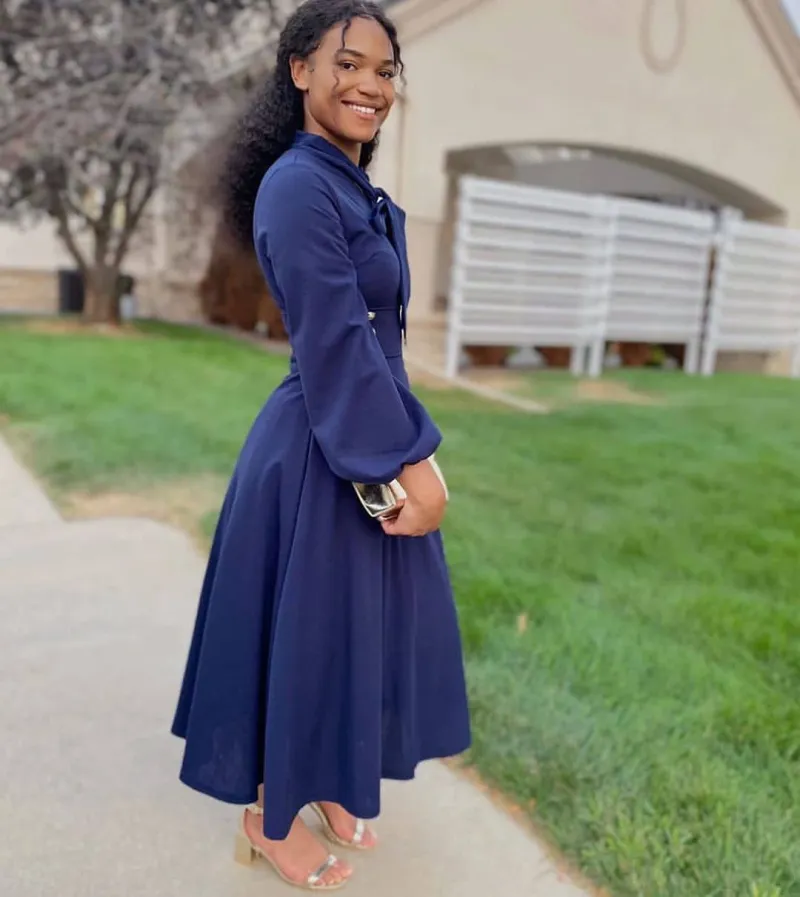
Photo: elegant confident woman in modest conservative outfit standing in natural light, via i.pinimg.com
There is a persistent cultural assumption that the woman who chooses to cover more is somehow choosing to say less. That a longer hemline signals withdrawal. That a buttoned collar communicates timidity. That layers, by their very nature, obscure not just the body but the person within it. This assumption is not merely incorrect — it is precisely backwards.
The woman who dresses modestly with intention is not erasing herself. She is, in fact, writing herself more clearly than almost anyone else in the room.
The Myth of Visibility
American culture has long conflated exposure with expression. Fashion media, advertising, and even casual social commentary have spent decades suggesting that a woman's truest self is most authentically communicated through what she reveals. Under this framework, coverage becomes concealment, and concealment becomes a kind of failure — a reluctance to participate, to be seen, to matter.
But visibility was never really about fabric. It was always about presence. And presence, as any quietly commanding woman will tell you, has nothing to do with the square footage of skin on display.
The women who turn heads in a room are rarely those who have simply removed the most material. They are the ones who have made the most deliberate choices — about color, silhouette, posture, and purpose. Modest dressing, at its finest, is precisely that kind of deliberateness made manifest.
Intention as the Foundation of Personal Style
Consider what it actually means to build a wardrobe around conservative principles. It requires thinking carefully about proportion. It demands an understanding of fabric and how it moves. It calls for a working knowledge of layering — how a silk blouse beneath a structured blazer creates a different kind of authority than either piece alone. It asks you to be thoughtful about color, about cut, about the message each combination sends before you have spoken a word.
This is not the wardrobe of a woman who has stopped thinking about herself. It is the wardrobe of a woman who has started thinking about herself with considerably more rigor.
There is a term in design circles — considered restraint — that describes the practice of removing the unnecessary so that what remains carries full weight. Modest dressing operates on exactly this principle. When you are not relying on exposure to generate interest, every other element of your outfit must do more meaningful work. The result, when executed well, is a style that communicates confidence, sophistication, and a deep familiarity with one's own aesthetic values.
Reclaiming the Narrative
For many women, the shift toward modest dressing is accompanied by an unexpected social experience: the need to explain oneself. Friends ask questions. Colleagues raise eyebrows. The cultural script is so thoroughly written around the idea that less coverage equals more freedom that choosing the opposite can feel, at first, like swimming upstream.
But here is what happens on the other side of that initial resistance: you stop needing to explain yourself at all.
When your clothing reflects a genuine internal conviction — whether rooted in faith, in personal philosophy, in an aesthetic sensibility, or simply in a hard-won sense of what makes you feel most like yourself — it carries an authority that requires no justification. People sense the difference between a woman who is dressed according to her own values and a woman who is dressed according to someone else's expectations. The former is magnetic in a way the latter rarely manages to be.
This is what modest dressing, at its most powerful, accomplishes: it removes you from the cycle of trend-chasing and approval-seeking and places you firmly inside your own sense of self. That is not restriction. That is sovereignty.
The Psychology of the Covered Silhouette
Research in behavioral psychology consistently demonstrates that clothing affects not just how others perceive us, but how we perceive ourselves. The concept of enclothed cognition — the idea that garments carry symbolic meaning that influences the wearer's psychological state — suggests that what we put on our bodies shapes how we move through the world in measurable ways.
For women who dress modestly, this phenomenon often manifests as a heightened sense of composure. When you are not self-conscious about hemlines riding up or necklines shifting, you are freed to be fully present in whatever room you occupy. Your mental energy, no longer spent on adjustment and self-monitoring, is available for the conversation, the meeting, the moment at hand.
This is an advantage that is rarely discussed openly, but it is real and it is significant. The woman who is comfortable in her clothes is the woman who can give her full attention to everything else. And that quality — that unhurried, unguarded attentiveness — is among the most compelling things a person can bring into any space.
Modest Dressing as a Form of Lasting Self-Definition
Trends, by their nature, are borrowed identities. Each season, the fashion industry offers women a new version of themselves to try on and discard. There is nothing inherently wrong with enjoying fashion's seasonal rhythms, but when a woman's entire sense of style is built on what is currently sanctioned by the culture, she is perpetually dependent on external permission to feel well-dressed.
Conservative dressing, grounded in timeless principles of elegance, proportion, and quality, operates outside this cycle. The woman who has developed a genuine modest aesthetic does not need a trend to validate her choices. Her wardrobe is an expression of who she is, not a reflection of what the moment demands.
This is the deepest form of self-definition available through clothing: not the declaration of a season's preferences, but the cultivation of a lasting personal identity — one that remains coherent and recognizable across years, occasions, and life chapters.
An Invitation, Not an Argument
None of this is meant to suggest that modest dressing is the only legitimate path to personal style. Fashion is a broad and generous language, and women of every aesthetic sensibility deserve to feel at home within it.
But for the woman who has felt the pull toward coverage — who has wondered whether her instinct to dress more conservatively is a retreat from something or a movement toward it — this is an invitation to consider the latter. To recognize that choosing modesty is not choosing invisibility. It is choosing, quite specifically and quite powerfully, to be seen on your own terms.
And in a culture that rarely stops telling women how they ought to look, that choice is among the most self-defining ones available.