The Power of Repetition: How a Modest Workwear Rotation Quietly Commands the Room Every Day
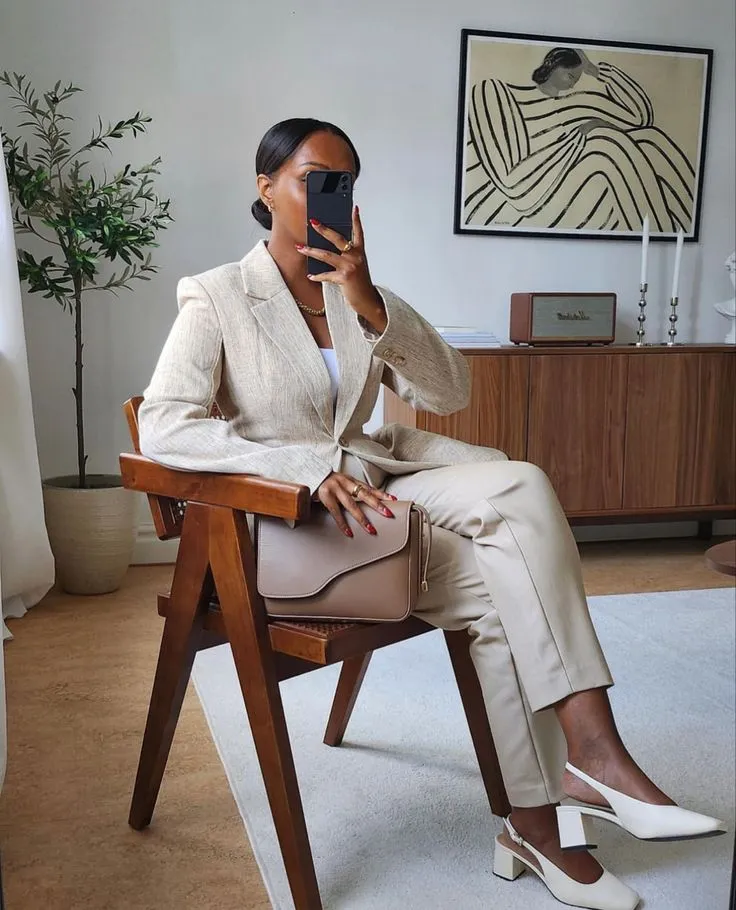
Photo: professional woman tailored modest workwear neutral tones office, via i.pinimg.com
There is a particular kind of confidence that belongs to the woman who enters a room looking as though she dressed without effort—as though the precision of her appearance is simply a natural extension of how she moves through the world. That impression, more often than not, is not accidental. It is the product of a carefully assembled wardrobe system: a modest workwear rotation built not on impulse, but on intention.
For the professional woman navigating competitive environments, clothing is not merely personal expression. It is professional communication. And a wardrobe that works as hard as you do begins not with individual pieces, but with a coherent strategy.
Why a Uniform Mindset Elevates Authority
The concept of a workwear uniform has long been embraced by executives, creatives, and public figures who understand that decision fatigue is a genuine drain on cognitive resources. When the question of what to wear is resolved before the week even begins, mental energy is redirected toward the work itself. For the modest dresser, this principle carries additional weight: a curated rotation of covered, tailored pieces signals consistency, discipline, and a quiet self-assurance that no trend-chasing wardrobe can replicate.
Consistency, when it is elegant, reads as authority. The woman who appears week after week in refined silhouettes—whose coverage is intentional, whose palette is cohesive—projects a professionalism that is deeply persuasive. She is not formulaic. She is composed.
Building Your Foundation: The Cohesive Color Architecture
The most effective modest workwear rotations are built on what designers call a color architecture: a deliberate palette in which every piece relates harmoniously to every other. For professional settings across the United States—whether a corporate office in Chicago, a law firm in Washington, D.C., or a financial institution in New York—this typically means anchoring the wardrobe in two or three neutrals, then introducing one or two accent tones that carry across the season.
Consider a foundation of navy, charcoal, and ivory. These three neutrals already offer considerable range. A tailored navy wide-leg trouser pairs with an ivory long-sleeve blouse and a charcoal blazer for a complete ensemble. The same trouser pairs with a charcoal turtleneck and a structured navy cardigan for an entirely distinct look. Add a deep burgundy or forest green as an accent—appearing in a midi skirt, a scarf, or a refined shell—and the visual vocabulary of the rotation expands dramatically without introducing chaos.
The discipline of color architecture is what prevents a uniform rotation from feeling monotonous. When every piece belongs to the same family, mixing becomes effortless and the results consistently look deliberate rather than assembled in haste.
The Silhouette Framework: Modest Tailoring as Professional Strategy
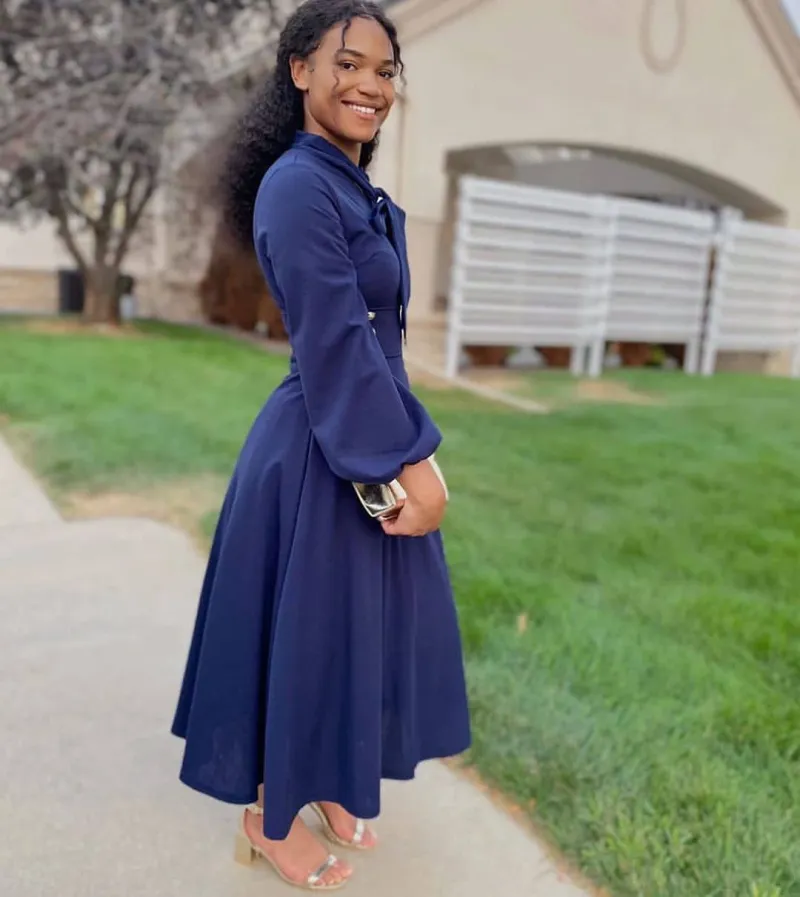
Beyond color, the second pillar of an effective rotation is silhouette consistency. This does not mean that every outfit must look identical—it means that the shapes you favor should share a common language. For modest professional dressing, this language typically includes clean lines, structured shoulders, covered necklines, and hemlines that fall at or below the knee.
Within that framework, there is generous room for variety. A pencil skirt and a wide-leg trouser are entirely different silhouettes, yet both communicate the same elegant restraint when they share the same tailored quality. A longline blazer and a belted wrap cardigan occupy different visual spaces, yet both contribute to a covered, intentional aesthetic.
The practical goal is to select pieces whose silhouettes are interchangeable at the component level. Tops must work with both skirts and trousers. Outer layers must complement every bottom in the rotation. When each item is chosen with this interchangeability in mind, a wardrobe of twelve to fifteen pieces can yield thirty or more distinct outfits—more than enough to carry a professional woman through a month without repetition.
The Core Pieces: What Every Modest Workwear Rotation Needs
A well-functioning rotation for the modest professional typically includes the following categories, each represented by two to three pieces:
Tailored Trousers: Wide-leg and straight-leg cuts in neutral tones form the backbone of the rotation. Look for a fabric weight that holds its shape through a full workday—wool-blend or ponte knit both perform admirably in four-season climates.
Midi and Maxi Skirts: A structured midi in a solid neutral and a softly pleated or A-line midi in a complementary tone offer variety at the lower half without straying from the modest silhouette.
Covered Blouses and Long-Sleeve Shells: These are the workhorses of the rotation. Invest in quality here—a beautifully draped long-sleeve blouse in silk or a refined crepe communicates far more than a hurried polyester substitute ever could.
Blazers and Longline Cardigans: A single well-fitted blazer is one of the most authoritative garments in a professional woman's wardrobe. A longline cardigan in a complementary tone offers a softer alternative for days when the environment calls for slightly less formality.
Layering Pieces: Turtlenecks, fitted mock-neck shells, and fine-knit underlayers extend the wearability of every piece in the rotation and make the wardrobe genuinely season-flexible.
Keeping the Rotation Fresh: The Role of Accessories
A modest workwear rotation does not rely on novelty for visual interest—it relies on refinement. And within a refined system, accessories serve as the mechanism of daily variation. A single structured handbag in a neutral leather grounds the entire wardrobe. A silk scarf, folded and draped at the collar or tied at the wrist, introduces color and texture without disrupting the palette. A pair of pearl earrings one day and a simple gold bangle the next shift the register of an outfit subtly but meaningfully.
The key is restraint. Accessories in a uniform rotation are not statements—they are punctuation. They complete the sentence without rewriting it.
Appearing Intentional, Never Formulaic
The concern most women raise when considering a workwear rotation is the fear of appearing as though they lack imagination. This concern, while understandable, reflects a misreading of how professional environments actually operate. Colleagues and supervisors do not catalog your outfits. They register your overall impression—and an impression built on consistent elegance and modest tailoring is one that accumulates over time into genuine professional authority.
The woman who is always impeccably covered, always polished, always composed in her appearance becomes associated with those qualities in every context. Her clothing does not distract from her competence—it reinforces it.
That is the quiet power of the modest workwear rotation. It is not a compromise between variety and practicality. It is a strategy for ensuring that every morning, without fail, you walk into the room looking like exactly the woman you intend to be.