Dressed with Intention: The Science Behind Why Strategic Coverage Amplifies Professional Confidence

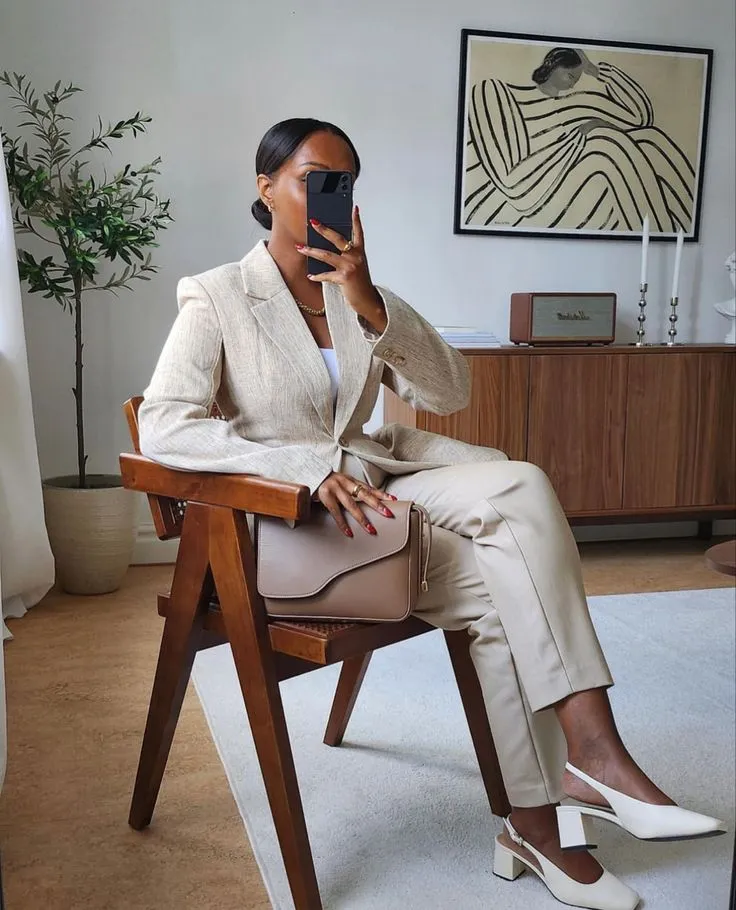
Photo: confident professional woman in elegant modest business attire boardroom, via img.freepik.com
There is a quiet revolution unfolding in American offices, boardrooms, and conference halls—one that has nothing to do with hemlines rising and everything to do with the deliberate choice to cover. Women who dress modestly in professional settings are increasingly being recognized not as anachronisms, but as architects of a particularly powerful form of personal authority. And now, research is beginning to explain why.
At Modestly Yours, we have long held that elegance rooted in intentionality carries its own weight. The data, it turns out, agrees.
What the Research Reveals
A body of work emerging from fields as varied as organizational psychology, behavioral economics, and social cognition has begun to illuminate the relationship between clothing choices and professional self-perception. A widely cited study from the Kellogg School of Management found that individuals who dressed in a manner they perceived as formal and authoritative reported significantly higher levels of abstract thinking—the kind of broad, strategic cognition associated with leadership roles. Crucially, this effect was driven not by how others perceived them, but by how they perceived themselves.
Separate research published in the Journal of Experimental Social Psychology introduced the concept of "enclothed cognition"—the idea that clothing carries symbolic meaning that the wearer internalizes, influencing both mental performance and emotional state. When a woman dresses in a manner that aligns with her values and her professional aspirations, she is not merely presenting an image to the world. She is actively reinforcing a psychological identity.
For women who embrace modest dressing, this mechanism is particularly potent. The act of choosing coverage is, by its very nature, an act of intention. There is nothing accidental about a well-tailored long-sleeve blouse, a perfectly proportioned midi skirt, or a structured blazer that closes with quiet authority. Every element is chosen. And that sense of agency, researchers suggest, is foundational to confidence.
Decision Fatigue and the Clarity of Conviction
One of the less-discussed advantages of a modest wardrobe is its relationship to cognitive clarity. Decision fatigue—the well-documented phenomenon by which the quality of decisions deteriorates after a long session of decision-making—is a genuine obstacle in professional life. The more choices one must make before the workday begins, the fewer cognitive resources remain for the decisions that actually matter.
A wardrobe built around modest principles naturally gravitates toward cohesion. Pieces are chosen for their versatility, their quality, and their alignment with a consistent aesthetic standard. The result is a morning routine that requires significantly less deliberation. When a woman already knows that her clothing will be elegant, covered, and appropriate for any professional context she encounters, she arrives at her desk with her mental reserves intact.
This is not a trivial advantage. Studies on executive performance consistently identify early-morning decision-making as a high-stakes cognitive window. Women who have effectively pre-decided their professional presentation—through a thoughtfully curated, values-aligned wardrobe—enter that window with a measurable edge.
Testimonials from the Professional World
Beyond the data, the lived experiences of modestly dressed professional women offer compelling testimony. Margaret, a corporate attorney based in Chicago, describes her transition to a fully modest professional wardrobe as "the single most clarifying decision" she made in her career. "I stopped spending energy managing my appearance in real time," she explains. "I wasn't adjusting, second-guessing, or wondering whether I was dressed appropriately for a particular meeting. I simply walked in, and I was present."
Similar sentiments emerge from women across industries. A senior administrator at a university in the Southeast describes modest dressing as "a kind of professional armor—not because it hides anything, but because it removes distraction and lets my work speak first." A financial advisor in Dallas notes that her clients consistently describe her as "authoritative" and "trustworthy"—descriptors she connects directly to the composed, covered presentation she brings to every appointment.
These accounts reflect something the research supports: that modest dressing, when chosen with conviction rather than obligation, produces a particular quality of professional presence. It is unhurried. It is unambiguous. It communicates that the woman wearing it has already resolved the question of who she is.
The Psychology of Redirected Attention
One of the more nuanced arguments in favor of modest professional dressing concerns the direction of attention—both the wearer's and the observer's. When clothing is designed to reveal, it inherently draws the eye toward the body. When clothing is designed to cover with elegance, attention is naturally redirected toward the face, the posture, the voice, and the words.
This is not a moral argument. It is a practical one. In a professional context, where ideas, competence, and judgment are the currencies that matter most, clothing that focuses attention on those qualities rather than on physical form is a strategic asset. Women who dress modestly in professional settings are, whether consciously or not, engineering the terms of engagement in their favor.
Research in nonverbal communication supports this reading. Studies consistently show that observers form rapid, lasting impressions based on initial visual cues. A woman whose clothing is polished, covered, and coherent signals—before she has spoken a single word—that she is serious, prepared, and in command of her environment.
Building Your Own Confidence Architecture
If the evidence points toward modest dressing as a genuine professional asset, the logical question becomes: how does one build a wardrobe that delivers this advantage consistently?
The answer lies in intentionality at every level. Begin with fit—clothing that is well-fitted to your actual body, rather than simply sized to cover it, communicates care and precision. Progress to fabric—structured materials such as ponte, crepe, and wool-blend hold their shape through long professional days and convey a seriousness that softer, drapier fabrics do not always achieve. Attend to color—a palette built around navy, charcoal, ivory, and warm neutrals reads as authoritative across virtually every professional context in the United States.
Finally, consider the cumulative effect of your choices. A modest wardrobe that has been built deliberately, over time, with attention to quality and coherence, becomes something greater than the sum of its parts. It becomes a statement of professional identity—one that requires no explanation, no defense, and no adjustment. It simply arrives, fully formed, and commands the room.
Confidence Is Not Exposure—It Is Clarity
The cultural narrative that equates confidence with visibility—with skin shown, silhouettes revealed, and coverage minimized—is one that the research does not support and that the experiences of modestly dressed professional women actively contradict. Confidence, in its most durable form, is not about what is revealed. It is about what is resolved.
When a woman dresses with intention, in alignment with her values, with attention to the impression she wishes to make and the professional she aspires to be, she carries into every room a quality that no amount of exposure can manufacture: the unshakeable assurance of a woman who has already decided who she is.
That, at its core, is the confidence equation. And modest dressing, it turns out, solves it beautifully.