The Liberating Power of Fewer Choices: How a Curated Modest Wardrobe Builds Unshakeable Daily Confidence
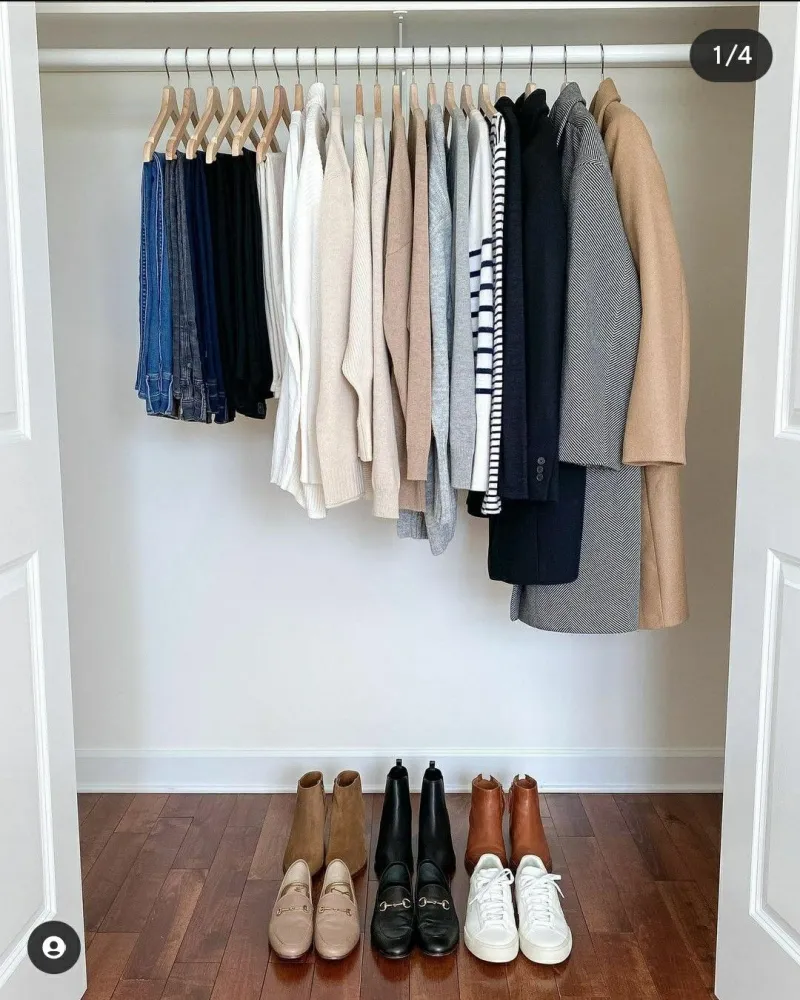
Photo: elegant woman organized minimal closet neutral wardrobe conservative fashion, via i.pinimg.com
There is a particular kind of exhaustion that arrives before the day has truly begun. You stand before a closet crowded with options — garments purchased impulsively, trends chased and abandoned, pieces that never quite fit the life you are actually living — and the simple act of choosing what to wear becomes its own small ordeal. By the time you leave the house, something has already been spent. Not money. Not time, precisely. Something more valuable: mental clarity.
This phenomenon has a name. Psychologists call it decision fatigue, and its effects are well-documented. The more choices a person is required to make, the lower the quality of each subsequent decision. It is the same cognitive principle that leads judges to grant parole more generously in the morning than in the afternoon, and that prompts grocery shoppers to reach for the familiar rather than the considered when they are simply too tired to think. Every unnecessary choice extracts a toll, and a disorganized wardrobe extracts that toll before breakfast.
What the women of the modest fashion community have long understood — often instinctively, before the research caught up — is that deliberate restraint in dressing is not a limitation. It is, in fact, a form of freedom.
The Psychology of the Pared-Down Closet
Research from Columbia Business School and other institutions has consistently demonstrated that an abundance of options does not increase satisfaction. It frequently diminishes it. When choices multiply beyond a manageable threshold, people become paralyzed, second-guess themselves, and ultimately feel less confident in whatever they do select. This is as true of salad dressings in a supermarket aisle as it is of blouses hanging in a wardrobe.
A modest wardrobe, by its very nature, operates within a defined aesthetic framework. Hemlines fall below the knee. Necklines remain conservative. Sleeves provide coverage. Arms, shoulders, and décolletage are not items on the daily negotiation table. These parameters, which some might perceive as restrictions, actually function as editorial guidelines — the kind that experienced stylists and designers rely upon to produce coherent, purposeful collections.
When you dress within a considered framework, the number of genuine decisions you must make each morning shrinks dramatically. You are no longer asking: What will I wear today? You are asking the far more manageable question: Which of my well-chosen pieces serves today's occasion best? The difference between those two questions is the difference between anxiety and confidence.
Intention as the Foundation of Style
There is a reason that many of history's most accomplished women — and men, for that matter — have been known for a kind of personal uniform. The deliberate repetition of a considered aesthetic is not a failure of imagination. It is an expression of it. When your wardrobe is built around timeless, modest pieces that work in harmony with one another, getting dressed becomes an act of affirmation rather than negotiation.
Consider what this looks like in practice. A wardrobe anchored by a handful of well-tailored trousers, a selection of elegant blouses in a restrained color palette, two or three quality skirts that fall gracefully below the knee, and a layering piece for each season does not feel sparse to its owner. It feels sufficient. Every item earns its place. Every morning encounter with that closet is a reminder that you have already made the important decisions — and made them well.
This is the quiet confidence that modest dressing cultivates. It is not the confidence of spectacle or novelty. It is the deeper, more durable confidence of a woman who knows exactly who she is and has built her external world to reflect that knowledge.
From the Closet to the Boardroom — and Beyond
The benefits of this mental clarity do not stay neatly folded in the wardrobe. Women who have intentionally curated their modest wardrobes frequently report a kind of cognitive spillover: the decisiveness they practice each morning begins to inform how they approach meetings, conversations, creative projects, and personal goals.
This is not coincidental. When you remove unnecessary friction from one area of your life, you free up cognitive resources for others. The mental energy previously consumed by wardrobe chaos becomes available for the work that genuinely requires your attention. A woman who is not quietly second-guessing her outfit throughout the day is a woman who is fully present — in the office, in her community, in her relationships.
Modest dressing, at its most thoughtful, is a form of self-governance. It reflects a commitment to values that extend well beyond hemlines: intentionality, discipline, clarity of purpose. These are not incidental qualities. They are the building blocks of a life lived with genuine conviction.
Building Your Edited Wardrobe: Where to Begin
If the prospect of simplifying your wardrobe feels daunting, begin with what you actually wear. Not what you intend to wear, or what you wore three years ago, or what seemed sensible at the time of purchase. What do you reach for, week after week, because it fits well, feels right, and requires no second-guessing?
Those pieces are the foundation of your curated wardrobe. They reveal your genuine preferences, your actual lifestyle, and the aesthetic that already feels most authentically yours. From there, the work is one of refinement rather than reinvention.
A few guiding principles:
Prioritize cohesion over variety. A wardrobe in which every piece speaks to every other piece is infinitely more functional than one full of interesting items that refuse to collaborate. A restrained color palette — neutrals anchored by one or two considered accent tones — is the simplest path to this kind of harmony.
Choose quality over quantity, always. A single beautifully constructed blouse in a fine fabric will serve you better, and bring more quiet pleasure, than five mediocre alternatives. The investment in quality is also an investment in confidence.
Let modest parameters work for you. Rather than experiencing coverage requirements as a constraint, embrace them as the editorial guidelines they truly are. They simplify decision-making, elevate your overall aesthetic, and ensure that your wardrobe always reflects a standard of elegance.
Revisit and refine regularly. A curated wardrobe is not a static archive. It is a living collection that should be reviewed seasonally, with items that no longer serve your life graciously released to make room for those that do.
The Quiet Radical Act of Enough
In a culture that profits from perpetual dissatisfaction — that sells the idea that the right outfit is always just one more purchase away — choosing to build a wardrobe around sufficiency rather than abundance is, in its own quiet way, a radical act. It is a declaration that you have already done the work of knowing yourself. That you do not require novelty to feel worthy of notice. That elegance is not a moving target but a standard you have chosen and committed to.
This is what modest fashion, at its most intentional, offers: not merely a set of style guidelines, but an entire philosophy of living. One that prizes clarity over clutter, purpose over impulse, and the deep, sustaining confidence that comes from dressing — and living — entirely on your own considered terms.
The wardrobe that contains less, it turns out, holds considerably more.